Picking the best aquarium wavemaker for reef tank setups comes down to matching flow pattern to coral type and tank shape, not chasing the highest GPH number on the box. This guide ranks five wavemakers by use case so you can skip the ones that don't fit your tank.
- EcoTech Marine VorTech MP40 QD is the best aquarium wavemaker for reef tank owners who want full app control and SPS-grade flow.
- Maxspect Gyre XF-series wins for wide, shallow tanks that need edge-to-edge laminar flow with no dead spots.
- Sicce Voyager Nano is the pick for nano and pico reef tanks under 40cm.
- Tunze Turbelle nanostream suits LPS and soft coral tanks where quiet, steady flow matters more than programmability.
- Jebao/Jecod SW-series is the budget entry point but has a shorter reported service life than the premium brands.
Why this matters
Flow is the difference between corals that colour up and corals that bleach or trap detritus in 2026 just as much as it was a decade ago. Too little movement and SPS frags get algae film on the base; too much direct flow and LPS polyps stay retracted and never feed properly.
The team at Krakking Korals sees the same pattern in customer tanks over and over: people buy one powerful wavemaker and point it straight at the rockwork, then wonder why half the tank barely moves. The right wavemaker for a reef tank is chosen for pattern and placement, not raw output.
What makes the best aquarium wavemaker for reef tank setups
- Turnover matched to coral type — SPS-dominant tanks want 10-20x tank volume per hour; LPS and soft coral tanks do better at 5-10x with gentler pulses.
- Programmability — random/reef-crest modes, pulse and wave patterns beat a single fixed-speed setting for coral health.
- Wireless or app control — lets you schedule feed mode, night mode and storm simulations without touching the tank.
- Mounting and glass compatibility — magnetic drive units need the right glass or acrylic thickness to hold securely.
- Cleaning and maintenance — impeller and gyre-bar designs collect detritus differently; some need a monthly strip-down, others don't.
- Reported reliability — how long the unit runs in a saltwater environment before the motor or magnet coupling fails.
At a glance
| Wavemaker | Best for | Standout feature | Key limitation |
|---|---|---|---|
| EcoTech Marine VorTech MP40 QD | Overall / SPS-dominant reefs | Full wireless app control with reef-crest and storm modes | Magnetic coupling needs the right glass thickness to hold |
| Maxspect Gyre XF-series | Wide, shallow tanks | Laminar, edge-to-edge flow with no dead corners | Gyre bar collects detritus and needs regular cleaning |
| Sicce Voyager Nano | Nano and pico tanks | Compact footprint that fits sub-40cm tanks | Limited random flow patterns compared to premium units |
| Tunze Turbelle nanostream | Quiet LPS/soft coral tanks | Analog dial control, no wireless syncing to worry about | Programmable random modes need a separate multicontroller |
| Jebao/Jecod SW-series | Budget builds | Lowest entry cost of the five with wireless control included | Known in the hobby for shorter service life than premium brands |
1. EcoTech Marine VorTech MP40 QD: best aquarium wavemaker for reef tank control
The VorTech MP40 QD drives water with a magnetically coupled wet side and a dry side controller mounted outside the glass, so there's nothing inside the tank but the pump head itself. It runs reef-crest, lagoon and short-pulse modes through the EcoTech mobile app, and it's one of the wavemakers Krakking Korals has stocked and run in-house on customer builds.
VorTech MP40 QD pros:
- App-based control over speed, pattern and feed mode without opening the lid
- Nothing but the pump body sits inside the water column, so no visible cord clutter
- Reef-crest and random modes genuinely change flow direction, not just speed
- Battery backup keeps pumps alive briefly during a power cut
VorTech MP40 QD cons:
- The magnetic drive coupling loses grip on extra-thick tank walls, so check your glass or acrylic thickness before buying
- Sits at the premium end of the category, which matters if you need three or four units for a large tank
- Firmware updates occasionally require a factory reset to resync the wireless link
Best for: SPS-dominant reef tanks where coral colour and polyp extension depend on varied, high-turnover flow. Verdict: Buy if programmability and app control matter more than upfront cost.
2. Maxspect Gyre XF-series: best aquarium wavemaker for reef tank width
The Gyre design pushes a wide column of water in one direction using a rotating propeller bar rather than a single directional jet. That gives it genuinely even, laminar flow across wide or shallow tanks where a standard powerhead leaves the far corners stagnant.
Gyre XF-series pros:
- Covers a much wider flow field per unit than a standard round powerhead
- Reduces the number of units needed on frag tanks and shallow display tanks
- Lower point-source turbulence, which suits delicate SPS frags on plugs near the outlet
Gyre XF-series cons:
- The rotating bar and end caps trap detritus and hair algae, so it needs more frequent cleaning than sealed impeller pumps
- Mounting brackets take up more visible space inside the tank than a compact powerhead
Best for: wide, shallow reef tanks and frag systems that need flow spread across the whole footprint rather than concentrated in one spot. Verdict: Buy for wide-format tanks; Skip on tall, narrow tanks where the gyre bar adds little over a standard pump.
3. Sicce Voyager Nano: best aquarium wavemaker for reef tank nano builds
The Voyager Nano is a compact, direct-drive powerhead built for tanks where a full-size wavemaker simply won't fit behind the rockwork. It's a straightforward fixed or variable-speed unit rather than a programmable flow computer.
Voyager Nano pros:
- Small enough to hide behind aquascaping in tanks under 40cm
- Simple controller dial, no app pairing or firmware to manage
- Runs quietly at lower flow settings, which suits nano LPS and soft coral mixes
Voyager Nano cons:
- No random or reef-crest flow patterns, just steady or pulsed output
- Output tops out well below what a mid-size SPS tank needs, so it's a poor fit outside nano and pico setups
Best for: nano and pico reef tanks where space behind the glass is the limiting factor. Verdict: Buy for tanks under 40cm; Skip for anything larger.
4. Tunze Turbelle nanostream: best aquarium wavemaker for reef tank quiet running
Tunze's Turbelle nanostream range uses a sealed, magnet-driven propeller with an analog controller dial rather than app software. It's built for long, unattended runtimes and is popular on LPS and soft coral tanks where a gentle, consistent current beats a chaotic one.
Turbelle nanostream pros:
- Very quiet operation, even at higher flow settings
- Sealed magnetic drive with a strong reputation for long-term reliability
- Controller dial adjustment doesn't depend on wireless pairing or an app
Turbelle nanostream cons:
- Random and reef-crest style programming needs the separate Tunze multicontroller unit
- Fewer flow-pattern options out of the box compared to app-driven pumps
Best for: LPS and soft coral tanks where steady, quiet flow matters more than programmable variety. Verdict: Buy for LPS/soft coral setups; Hold if you already run SPS and want reef-crest modes standard.
5. Jebao/Jecod SW-series: best aquarium wavemaker for reef tank budgets
The Jebao/Jecod SW-series wireless wavemakers pack app control, multiple flow modes and magnetic mounting into the lowest-cost bracket of the category. They cover the same basic feature list as the premium brands on paper.
Jebao/Jecod SW-series pros:
- Wireless app control and multiple flow modes at the lowest entry point in this list
- Magnetic mount design similar in principle to the premium units
- Widely available and easy to source replacement parts for
Jebao/Jecod SW-series cons:
- Known in the hobby for a shorter service life than EcoTech or Tunze units under continuous reef tank use
- Build tolerances vary between units more than the premium brands
- App interface and firmware are less polished than EcoTech's
Best for: hobbyists building a first reef tank on a tight budget who accept a shorter replacement cycle. Verdict: Buy as a starter unit; Hold off if you're stocking an established SPS tank you don't want to risk on a flow outage.
“If the flow doesn't reach every branch of your SPS colony, more powerheads won't fix bad rock placement.”
How we ranked these
Each wavemaker was measured against the criteria above: turnover suitability for coral type, programmability, wireless control, mounting compatibility, cleaning burden and reported reliability in the hobby. No two units share a "best for" slot — the ranking reads as a decision tree by tank type, not a single leaderboard.
Which wavemaker should you choose?
For most reef tanks running SPS or a mixed system in 2026, the EcoTech Marine VorTech MP40 QD is the best aquarium wavemaker for reef tank flow control and long-term reliability. Go Maxspect Gyre if your tank is wide and shallow, Sicce Voyager Nano if it's under 40cm, Tunze Turbelle if quiet LPS flow is the priority, and Jebao/Jecod if budget is the deciding factor for a first build.
FAQ
What is the best aquarium wavemaker for reef tank SPS coral?
The EcoTech Marine VorTech MP40 QD is the best aquarium wavemaker for reef tank setups running SPS coral in 2026, because its reef-crest and random flow modes match the varied turbulent flow SPS needs on the reef.
How many wavemakers does a reef tank need?
Most reef tanks run two wavemakers positioned to cross flow patterns rather than one large unit, which prevents dead spots and gives more even coverage across the rockwork.
Is a gyre pump better than a standard powerhead?
A gyre pump like the Maxspect Gyre spreads flow across a wider column of water, which suits wide or shallow tanks, but it needs more frequent cleaning than a sealed impeller powerhead.
Do LPS corals need less flow than SPS?
Yes. LPS and soft coral tanks generally do best around 5-10x tank volume turnover per hour, while SPS-dominant tanks want 10-20x with more turbulent, varied flow.
Can a budget wavemaker like Jebao run a reef tank long-term?
A Jebao or Jecod SW-series unit can run a reef tank, but it's reported in the hobby to have a shorter service life than premium brands like EcoTech or Tunze under continuous saltwater use.
Does a wavemaker need to be app-controlled?
No. Units like the Tunze Turbelle nanostream use an analog dial and run reliably without wireless pairing, though programmable random modes require a separate controller accessory.
What size wavemaker suits a nano reef tank?
A compact direct-drive unit like the Sicce Voyager Nano fits tanks under 40cm where a full-size wavemaker won't clear the aquascape.
One last thing
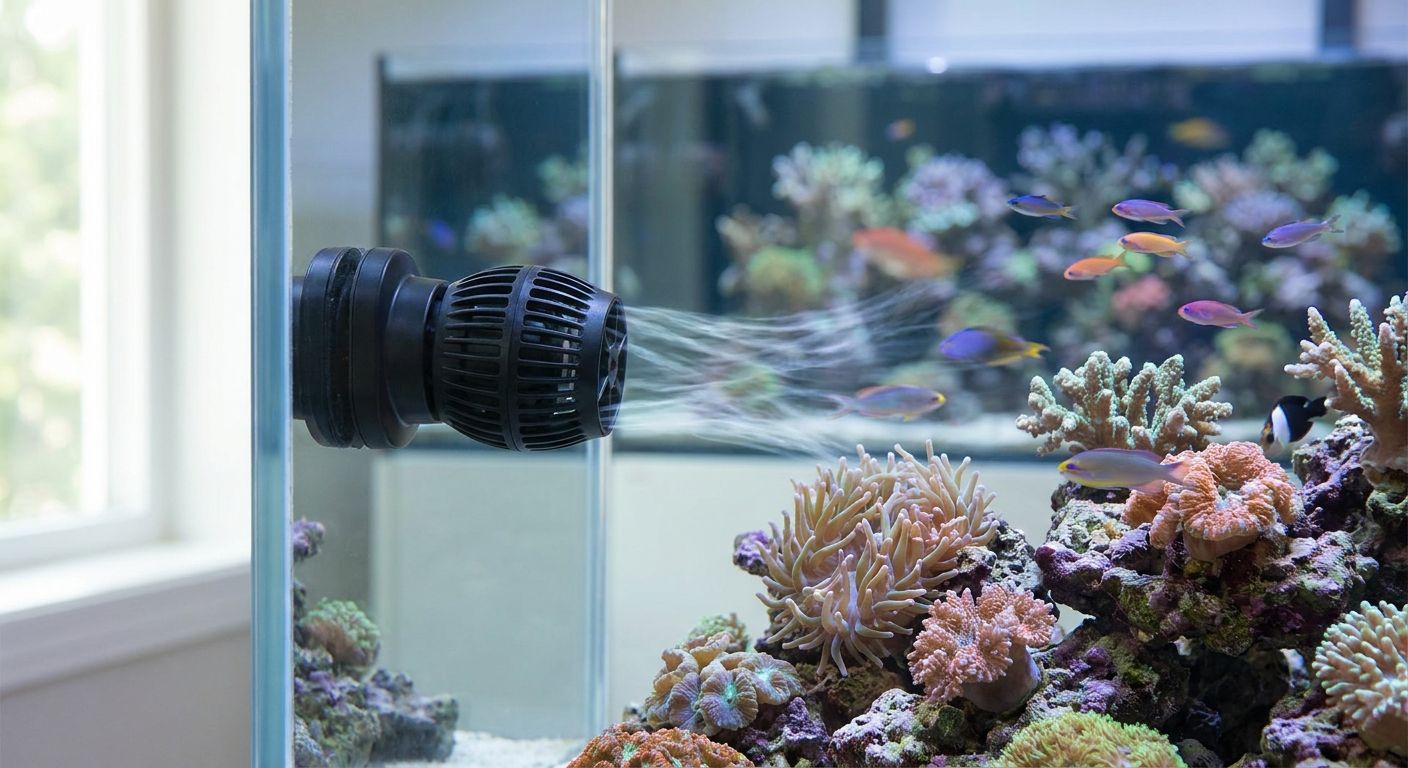
The single biggest flow mistake isn't the wavemaker choice, it's aiming both pumps at the same spot. Cross two units at roughly opposite corners so the flow collides mid-tank instead of running in a straight line, and even a mid-range wavemaker will outperform a premium unit pointed the wrong way.