Six fish make the cut for a beginner-safe saltwater tank in 2026, and the pecking order comes down to how well each one tolerates fluctuating water chemistry, ignores your coral, and eats without a fight. Best overall beginner marine fish: the Ocellaris Clownfish. Best budget-friendly pick: the Blue-Green Chromis. Best for a calm, slow-moving reef tank: the Banggai Cardinalfish. Best for adding colour under rockwork without bothering coral: the Royal Gramma.
- Ocellaris Clownfish is the best beginner marine fish for a saltwater tank in 2026 — hardy, reef safe, eats anything.
- Blue-Green Chromis schools cheaply and tolerates the swings of a tank still cycling.
- Coral Beauty Angelfish controls algae but can nip zoanthids and LPS polyps — skip it in a coral-heavy tank.
- Add one fish every 2-4 weeks after cycling to avoid an ammonia spike in a new system.
- A 75-litre (20-gallon) tank is the realistic minimum for most fish on this list.
Why this matters
Most beginner tanks fail on livestock choice, not equipment. A fish that needs pristine, stable water in a tank that's three weeks into cycling is a dead fish by week five — that's not bad luck, that's a mismatch between species and system maturity. The fish on this list were picked because they survive the wobble of a young tank and don't touch coral, which matters if you're planning to stock SPS, LPS or zoanthids down the track.
Start with the Krakking Korals livestock range once your tank has finished cycling — adding fish too early, before ammonia and nitrite have flatlined, is the single most common beginner mistake in the hobby. Everything below assumes a cycled tank with stable parameters, not day one of a new setup.
What makes the best beginner marine fish
- Tolerance for water chemistry swings — copes with ammonia/nitrite spikes better than sensitive species during and just after cycling
- Reef compatibility — won't nip zoanthids, LPS or SPS polyps once coral goes in
- Feeding ease — takes prepared frozen or pellet food from week one, no live food required
- Temperament — doesn't bully tankmates in a tank under 150 litres
- Predictable adult size — stays within the bounds of a starter tank instead of outgrowing it in 12 months
- Availability and hardiness in transit — ships and acclimates reliably, which matters for online ordering
Best beginner marine fish for saltwater tanks in 2026: at a glance
| Fish | Best for | Standout feature | Key limitation |
|---|---|---|---|
| Ocellaris Clownfish | Overall beginner pick | Pairs with anemone later, eats anything | Can get territorial once paired |
| Blue-Green Chromis | Cycling a new tank | Schools, tolerates rough water chemistry | Skittish, jumps if startled |
| Banggai Cardinalfish | Calm, slow-moving tanks | Barely swims, easy to target-feed | Slow eater gets out-competed by fast fish |
| Firefish Goby | Peaceful reef communities | Hovers near rock, ignores coral completely | Can jump from an open-top tank |
| Royal Gramma | Colour under rockwork | Holds deep purple/yellow colour under most lighting | Shy, needs caves to feel secure |
| Coral Beauty Angelfish | Algae control | Grazes film algae off rock and glass | Can nip zoanthids and LPS in some tanks |
1. Ocellaris Clownfish: best beginner marine fish for overall hardiness
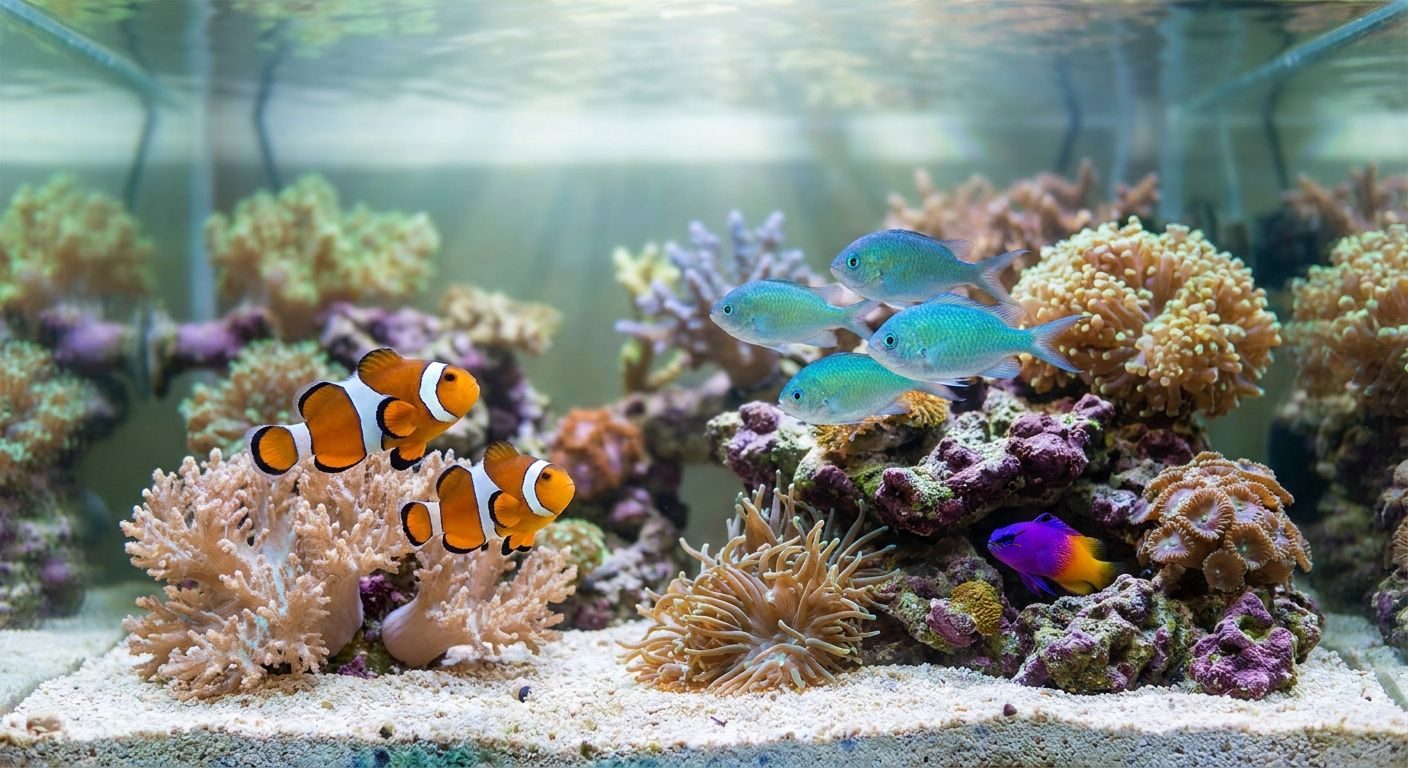
The Ocellaris Clownfish is the fish most reef keepers start with, and for good reason — it eats frozen mysis, pellets or flake from the first feeding and shrugs off the water quality swings of a tank still settling in. It stays under 8 cm as an adult, ignores coral entirely, and can be kept singly or as a mated pair once you're ready to add an anemone.
Ocellaris Clownfish pros:
- Eats prepared food immediately, no live food transition needed
- Fully reef safe with SPS, LPS and zoanthids
- Tolerates the chemistry swings typical of a tank in its first 4-6 weeks
- Widely available and easy to source year-round
Ocellaris Clownfish cons:
- Two clownfish in a tank under 100 litres can become territorial with each other
- Won't host in an anemone unless you introduce one deliberately
Best for: the first fish in almost any beginner saltwater tank. Verdict: Buy.
2. Blue-Green Chromis: best beginner marine fish for cycling a new tank
Blue-Green Chromis is the species most experienced reefers reach for when a tank has just finished cycling and needs its first bioload. It schools, so three to five individuals in a 150-litre-plus tank behave more naturally and spread out stress across the group instead of concentrating it in one fish.
Blue-Green Chromis pros:
- Handles the tail end of an ammonia/nitrite cycle better than most reef fish
- Inexpensive relative to most saltwater species, so a small school is achievable
- Schools peacefully, adds movement without aggression
- Completely ignores coral
Blue-Green Chromis cons:
- Jumps when startled — an open-top tank is a real risk
- Individual fish can look washed-out under weak lighting
Best for: stocking a tank that's just finished cycling. Verdict: Buy.
3. Banggai Cardinalfish: best beginner marine fish for a slow, calm tank
The Banggai Cardinalfish barely swims — it hangs in one spot near rockwork and picks off food as it drifts past, which makes it easy to target-feed and observe. It's a poor choice for a tank with fast, aggressive feeders because it will simply get out-competed at meal time.
Banggai Cardinalfish pros:
- Extremely calm temperament, never bullies tankmates
- Distinctive black-and-white striping and long fins
- Easy to target-feed with a turkey baster
- Fully reef safe
Banggai Cardinalfish cons:
- Slow eater — loses out to Chromis or damsels in the same tank
- Best kept singly or in a bonded pair, not a mixed group
Best for: a low-stocking-density reef tank without fast swimmers. Verdict: Buy.
4. Firefish Goby: best beginner marine fish for peaceful reef communities
The Firefish Goby hovers near a burrow or rock crevice and darts back in when it feels threatened, which makes it one of the least disruptive fish you can add to a tank already stocked with zoanthids or soft coral. It never touches coral tissue and rarely competes with other fish for food or territory.
Firefish Goby pros:
- Completely peaceful, never bullies or competes aggressively
- Ignores coral polyps entirely, safe with SPS and LPS
- Adds colour and movement in the lower third of the tank
- Eats small frozen foods readily
Firefish Goby cons:
- Known jumper — a tight-fitting lid or mesh cover is non-negotiable
- Can be shy for the first week or two after introduction
Best for: rounding out a peaceful reef community without adding aggression. Verdict: Buy.
5. Royal Gramma: best beginner marine fish for colour under rockwork
The Royal Gramma's split purple-and-yellow colouring holds up under most lighting setups, and it spends most of its time upside-down under ledges and overhangs, which makes it a good fit for tanks aquascaped with plenty of rock structure. It's shy at first but settles once it claims a cave.
Royal Gramma pros:
- Vivid, stable colouration that doesn't fade under standard reef lighting
- Reef safe with all common coral types
- Occupies a distinct swimming zone, doesn't compete with surface fish
- Long-lived compared to many small reef fish
Royal Gramma cons:
- Shy and needs caves or overhangs to feel secure
- Can be territorial toward other bottom-dwelling fish in a small tank
Best for: tanks with heavy rockwork and aquascaping already in place. Verdict: Buy.
6. Coral Beauty Angelfish: best beginner marine fish for algae control
The Coral Beauty Angelfish grazes film algae off rock and glass more effectively than any other fish on this list, which is useful in a tank that's still finding its nutrient balance. The trade-off is real: some individuals develop a habit of nipping zoanthid polyps or LPS mantle tissue, and there's no reliable way to predict which fish will do it before you buy.
Coral Beauty Angelfish pros:
- Genuinely useful algae grazer, reduces manual cleaning
- Striking blue-and-orange colouration
- Hardy once established, tolerates minor parameter swings
- Stays under 10 cm as an adult
Coral Beauty Angelfish cons:
- Can nip zoanthids, LPS and soft coral in a subset of individuals
- Not a safe default choice for a coral-dense display tank
Best for: a fish-dominant or lightly stocked reef tank with hardy coral only. Verdict: Hold — quarantine and observe behaviour before adding to a coral display.
How we ranked
Every fish above was scored against the six criteria up top: chemistry tolerance, reef compatibility, feeding ease, temperament, adult size, and shipping hardiness. The Ocellaris Clownfish and Blue-Green Chromis score highest across the board, which is why they sit at the top. The Coral Beauty Angelfish ranks last despite its usefulness because reef compatibility is inconsistent — that single weakness matters more in a coral tank than any of its strengths.
Which fish should you choose?
For most people setting up a first saltwater tank in 2026, the Ocellaris Clownfish is the default answer — it's hardy, reef safe, and forgiving of beginner mistakes. Add a small school of Blue-Green Chromis once the tank has finished cycling to build bioload safely, then layer in a Firefish Goby or Royal Gramma once coral is established. Save the Coral Beauty Angelfish for later, once you know exactly what's going into the display and can watch it in quarantine first.
FAQ
What is the best beginner marine fish for a saltwater tank in 2026?
The Ocellaris Clownfish is the best beginner marine fish for a saltwater tank in 2026 because it eats prepared food immediately, tolerates chemistry swings, and is fully reef safe.
How many fish can I add to a new saltwater tank at once?
Add one fish or one small school every 2-4 weeks after the tank finishes cycling. Adding several fish at once overloads the bacteria colony and causes an ammonia spike.
Are clownfish reef safe?
Yes, Ocellaris Clownfish are fully reef safe and won't touch zoanthids, LPS or SPS coral. They're one of the few fish that can be added to a coral-heavy tank with no restrictions.
Is a Coral Beauty Angelfish reef safe?
Inconsistently. Some Coral Beauty Angelfish leave coral alone entirely, while others nip zoanthid polyps or LPS mantle tissue. Quarantine and observe before adding one to a coral display.
What fish should go into a saltwater tank first, before coral?
Blue-Green Chromis or an Ocellaris Clownfish are the standard first additions once cycling is complete, since both tolerate the residual chemistry instability of a young tank.
Do beginner marine fish need a quarantine tank?
A separate quarantine tank isn't mandatory for hobby-scale setups, but it reduces the risk of introducing disease or aggressive individuals like a nippy Coral Beauty Angelfish into an established display.
What size tank do beginner marine fish need?
Most fish on this list do fine in a 75-litre (20-gallon) tank or larger. Schooling fish like Blue-Green Chromis need at least 150 litres for a group of three to five.
Can beginner marine fish live with corals right away?
Only after the tank has fully cycled and coral has been added separately. Fish and coral can coexist from day one of stocking, but the tank itself needs 4-6 weeks of cycling before either goes in.
One last thing
The fish that causes the most beginner disasters isn't on this list at all — it's whatever aggressive damsel a well-meaning local shop hands over as a "hardy starter fish" without mentioning it'll terrorize every peaceful species added after it. Stick to the six above, add them slowly, and the aggression problem never comes up.