If you're stocking your first saltwater tank in 2026, the clownfish is still the fish that gets people hooked on the hobby — but not every colour morph on the market is a smart first pick. This guide ranks five clownfish options sold through Krakking Korals by hardiness, temperament and how forgiving they are of beginner mistakes.
- The Percula Clownfish is the best clownfish for beginners overall in 2026 — hardy, widely available and forgiving of a slightly imperfect cycle.
- Black Clownfish is the best budget option for a first pair without paying for designer patterning.
- Snow Storm Clownfish gives beginners a genuinely different look without sacrificing the hardiness of standard clownfish stock.
- Platinum Clownfish suits reefers who want a showcase colour morph that doesn't depend on hosting an anemone.
- Every option here is captive-bred by Coastal Clownfish, which matters more for beginner survival rates than colour ever will.
Why this matters
Clownfish tolerate a wider swing in water parameters than almost any other marine fish, which is exactly why they're the standard first stock for a newly cycled tank. But "clownfish" now covers a dozen captive-bred colour lines, and not all of them behave the same once they mature and start staking out territory.
The classic Percula Clownfish is still the safest default for a beginner tank in 2026 — it's the line most captive-breeding programs have refined the longest, so genetic health and temperament are the most predictable. Everything else on this list trades some of that predictability for a different look or a lower price.
What makes the best beginner clownfish
- Hardiness in a freshly cycled tank — tolerance for the ammonia and nitrite swings a new tank still produces
- Captive-bred lineage — wild-caught clownfish carry more parasite risk and adapt to prepared foods more slowly
- Temperament as an adult — some colour lines get more territorial than others once paired
- Compatibility with nano and standard reef setups — does the fish need a large footprint to feel settled
- Colour and pattern stability — whether the morph holds its look as the fish grows, or fades toward standard orange
- Shipping realities — DOA cover and delivery exclusions differ by fish and matter if you're in WA, SA, NT, FNQ or TAS
At a glance
| Species | Best for | Standout feature | Key limitation |
|---|---|---|---|
| Percula Clownfish | Best overall beginner clownfish | Classic orange-and-white pattern, most predictable temperament | No DOA cover shipping to FNQ, WA or NT; not shipped to TAS |
| Black Clownfish | Best budget option | Solid black body that reads well under most reef lighting | No DOA cover for WA, NT or FNQ |
| Platinum Clownfish | Best for showcase colour without an anemone | Pearl-white body, minimal orange banding | DOA exclusions extend to SA and TAS on top of WA and FNQ |
| Snow Storm Clownfish | Best for a genuinely different pattern | High-white "storm" patterning from Coastal Clownfish | DOA cover excluded for FNQ, WA and SA |
| B Grade Storm Clownfish | Best for designer genetics on a tighter budget | Storm-line genetics without show-grade markings | Cosmetic imperfections are the trade-off |
1. Percula Clownfish: best clownfish for beginners overall
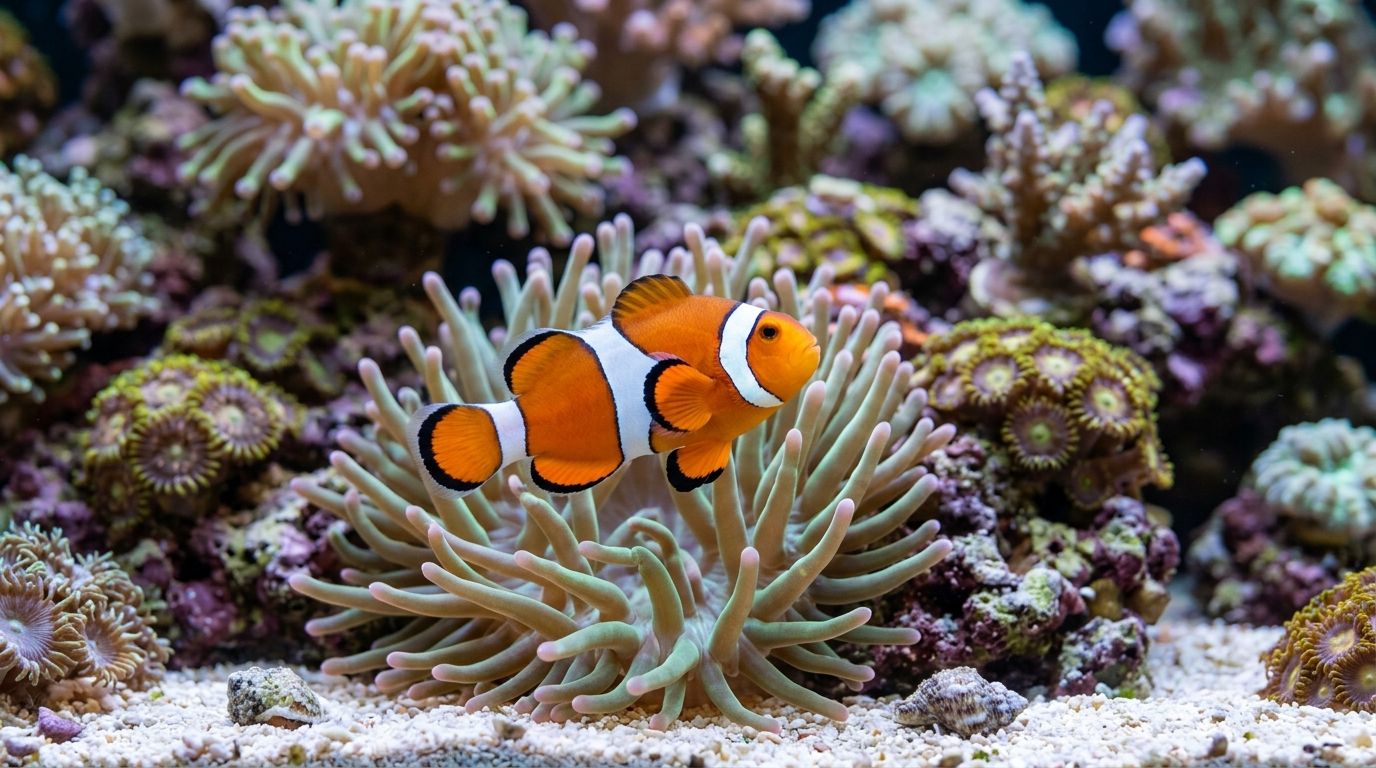
The Percula Clownfish is the fish most reefers picture when someone says "clownfish" — orange body, three white bars, black outlining. It's captive-bred, which means it's already adjusted to pellet and frozen foods before it ever reaches your tank, and it tolerates the parameter swings of a first-month cycle better than most marine fish on the market.
Percula Clownfish pros:
- Most predictable temperament of any line on this list
- Adapts fastest to prepared foods since it's raised captive from the start
- Doesn't need an anemone to settle in — will host in rockwork or a powerhead outflow
- Widely available, so restocking a pair later isn't a problem
Percula Clownfish cons:
- Colour is the least distinctive option here if you want something that stands out
- DOA cover does not apply for shipments to FNQ, WA or NT, and Tasmania isn't serviced at all
Best for: a first marine fish in a tank that's just finished cycling. Verdict: Buy.
2. Black Clownfish: best clownfish for a tight budget
The Black Clownfish is a solid, near-fully black morph that arrives at roughly 3-4cm — small enough to settle into a nano setup without dominating it early on. It gives you the same beginner-friendly hardiness as the standard Percula line in a colour that photographs well against pale coral.
Black Clownfish pros:
- Same captive-bred hardiness as the Percula line
- Distinct colour without paying for a premium designer pattern
- Compact 3-4cm size at arrival suits smaller display tanks
Black Clownfish cons:
- No DOA cover for shipments to WA, NT or FNQ
- Black morphs can show faint orange patches as juveniles before settling fully dark
Best for: beginners who want colour contrast without spending up for a Storm-line fish. Verdict: Buy.
3. Platinum Clownfish: best for a showcase colour without an anemone
The Platinum Clownfish trades the classic orange for a pearl-white body with minimal banding — a fish that reads as a centrepiece even before you've added an anemone host. It arrives at approximately 3-4cm and is captive-bred through the same Coastal Clownfish program as the rest of this list.
Platinum Clownfish pros:
- Stands out immediately against live rock and most coral colours
- No anemone required to look like a display fish
- Captive-bred hardiness carries over from the standard lines
Platinum Clownfish cons:
- DOA exclusions cover WA, FNQ, SA and TAS — the broadest shipping restriction on this list
- Pattern can shift slightly as the fish matures, so what you see at 3-4cm isn't always the final look
Best for: reefers who want a striking fish without committing to anemone care. Verdict: Buy.
4. Snow Storm Clownfish: best for a genuinely different pattern
The Snow Storm Clownfish is a high-white "storm" morph bred specifically to look different from the standard three-bar Percula pattern, arriving at roughly 3-4cm. It's the pick for a reefer who's kept a standard clownfish before and wants variety in a second or third fish.
Snow Storm Clownfish pros:
- High-white patterning that's genuinely distinct from standard clownfish stock
- Captive-bred by Coastal Clownfish with the same care lineage as the rest of the range
- Settles well in both nano and standard reef tanks
Snow Storm Clownfish cons:
- DOA cover excluded for FNQ, WA and SA
- Storm-line patterning varies fish to fish, so no two arrive identical
Best for: a second clownfish for a tank that already has a standard pair or single fish. Verdict: Buy.
5. B Grade Storm Clownfish: best for designer genetics on a tighter budget
The B Grade Storm Clownfish carries the same Storm-line genetics as the standard Snow Storm and Black Storm fish, just without show-grade markings — think slightly asymmetrical banding rather than a flaw in health or hardiness. Size at arrival runs roughly 3-4cm, same as the rest of the Storm line.
B Grade Storm Clownfish pros:
- Storm-line genetics at a more accessible grading tier
- Same captive-bred hardiness as show-grade Storm fish
- Good option if pattern symmetry matters less to you than the underlying bloodline
B Grade Storm Clownfish cons:
- Cosmetic imperfections are the entire trade-off — this isn't a fish for someone chasing a perfect show pattern
- DOA cover excluded for FNQ, WA and SA
Best for: buyers who want Storm-line genetics but don't need competition-grade markings. Verdict: Hold if pattern symmetry matters to you; Buy if it doesn't.


Which clownfish should you choose?
If you're not sure, buy the Percula Clownfish — it's the most forgiving choice for a tank that's still settling in during 2026, and it's the easiest to source again later if you want a second fish. Reach for the Black Clownfish if budget is the deciding factor, and go Platinum or Snow Storm once you want a display fish that looks different from every other reef tank on your Facebook group feed.
A properly sized tank matters as much as the fish you pick — most clownfish pairs settle well in setups from around 80 litres upward, which is why a compact option like the Aqua One NanoReef 80 works for a lot of first-time clownfish keepers rather than jumping straight to a large reef build.
FAQ
What's the best clownfish for beginners in 2026?
The Percula Clownfish is the best clownfish for beginners in 2026 because it's captive-bred, tolerant of a still-settling nitrogen cycle, and the most predictable in temperament. Storm-line and Platinum morphs are good second choices once you've kept a standard clownfish successfully.
Do clownfish need an anemone to survive?
No, clownfish do not need an anemone to survive in a home aquarium. They'll happily host in rockwork, coral colonies or even a powerhead outflow instead.
How big does a beginner clownfish tank need to be?
Most clownfish pairs do well in tanks from roughly 80 litres upward. A nano tank in that range gives a pair room to establish territory without overcrowding a first reef build.
Are captive-bred clownfish better than wild-caught?
Yes, captive-bred clownfish are better for beginners because they're already adjusted to prepared foods and tank conditions before they ever reach your aquarium. Every clownfish listed in this guide is captive-bred by Coastal Clownfish.
Can you keep two clownfish together in a nano tank?
Yes, a mated or juvenile pair can share a nano tank, but clownfish form a strict size-based hierarchy where the larger fish becomes dominant. Introduce two similarly sized juveniles together rather than adding a second fish to an established adult later.
Is the Percula Clownfish the same as an Ocellaris Clownfish?
They're closely related but not identical — true Percula and Ocellaris clownfish are separate species that look similar, distinguished mainly by black outline thickness and dorsal spine count. Both are captive-bred and equally suitable for a beginner tank.
How long do clownfish live in a home aquarium?
Well-kept clownfish commonly live past 10 years in a stable reef tank. Stable water parameters and a predator-free tank matter more to lifespan than which colour morph you choose.
What does DOA cover mean when buying a clownfish online?
DOA cover refers to dead-on-arrival protection for fish shipped interstate. Most clownfish listings, including several in this guide, exclude DOA cover for deliveries to WA, SA, NT or FNQ, so check the shipping terms on the specific listing before ordering.
One last thing
Every clownfish is born male — the dominant fish in a pair converts to female as it matures, which is why buying two similarly sized juveniles together works better than adding a second fish to an already-established adult in 2026. Pair a Percula Clownfish with a Tropic Marin Pro Reef Salt Mix for water changes and you've covered the two things that actually determine survival in the first month — stable salinity and a fish that was bred for tank life from day one.